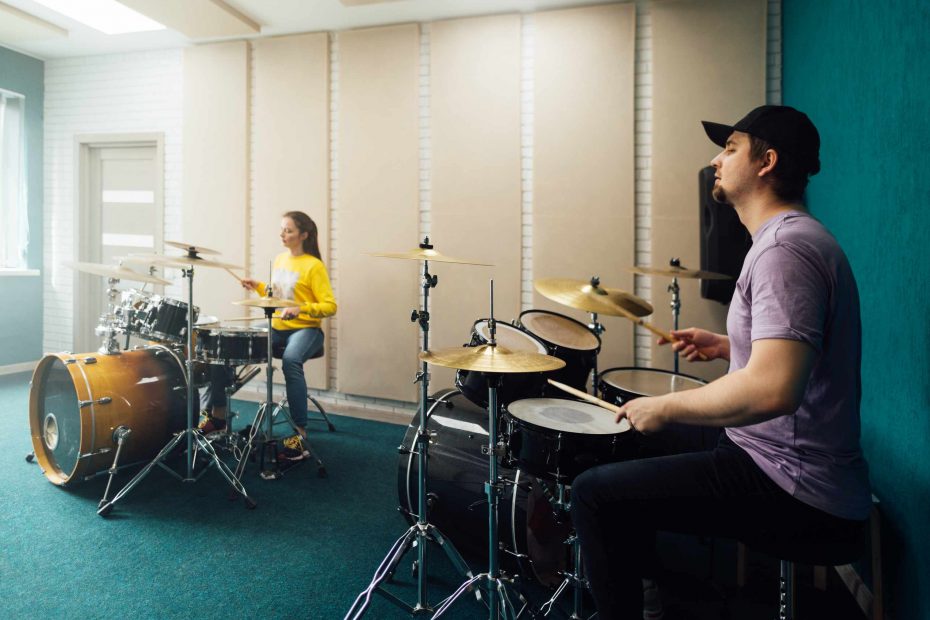
A groove is what grounds the music. It is a repeating pattern that establishes the pulse and provides a solid center for the audience to feel. On a standard drum set, a basic groove consists of consistent hi-hat eighth notes, snare drum backbeats on counts two and four, and a bass drum pattern that supports the pulse. You don’t need to play something complex for it to be a groove. The most important function of the groove is to maintain time.
In contrast, the role of a fill is to disrupt the pattern of the groove briefly, usually in order to land the drummer back into the groove of the next bar, musical phrase, or section of the song. A fill can consist of moving from snare drum to tom-tom, inserting some faster notes, or ending on the next downbeat with a crash cymbal. The fill is a cue for the music: “We’re turning around,” “We’re finishing up,” or “Something’s about to change.” The most important thing about the fill is that it should not cause you to lose the feel of your time.
Often, beginner drummers are playing fills that are actually faster or flashier than their grooves. If this happens, you will find yourself speeding up as the fill happens, missing your beat, and landing your crash cymbal slightly ahead of or behind your time. This is especially true when you only play fills in the first half of the bar; you may find yourself playing a bar fill that is pulling the tempo ahead by quite a lot, and you don’t even realize it at the time! This is why it is always a good idea to practice your fills alongside the groove before and after it.
Start with a simple two-bar musical idea. In the first bar, you play the same groove with hi-hat, snare drum, and bass drum. In the second bar, you play three or four relatively slow-moving notes with the snare drum or toms, and then you return to the groove in the next bar. Count these two bars out loud. The key to practicing this exercise is in hearing the return to the groove; don’t just pay attention to the fill itself. If it feels like the groove you’re returning to is shaky, the fill is too busy or too fast to start with.
Another way to think about it is to consider what is happening rhythmically. The groove is where “here is the time.” The fill is where “we are moving to the next location.” If both are happening all at once, it sounds like a fight for the attention of the listener. Keep your groove consistent and simple until you can start to add more color or variety to your fill. One simple and clean snare to tom movement in time is better than an unnecessarily long roll that loses the downbeat.
Dynamic control is another important factor. One way that a fill fails is when all the notes are played as loudly as possible. Try playing the groove at a normal volume and then only accent the final note of your fill a little bit. This teaches your hands to learn how to accent notes instead of using brute strength, and it helps the listener hear your fill as its own melodic shape.
The most obvious test you can perform in your playing: can you play a fill and land back in your groove without tripping over yourself, laughing, or hunting for the time of the downbeat? Yes? Well, good job. You’re probably on your way! No? Take it slow, take it easy, and make sure you’re giving yourself space. Any drummer can learn to be comfortable returning to a groove, and that is one of the most critical skills to master in your first few years of playing!