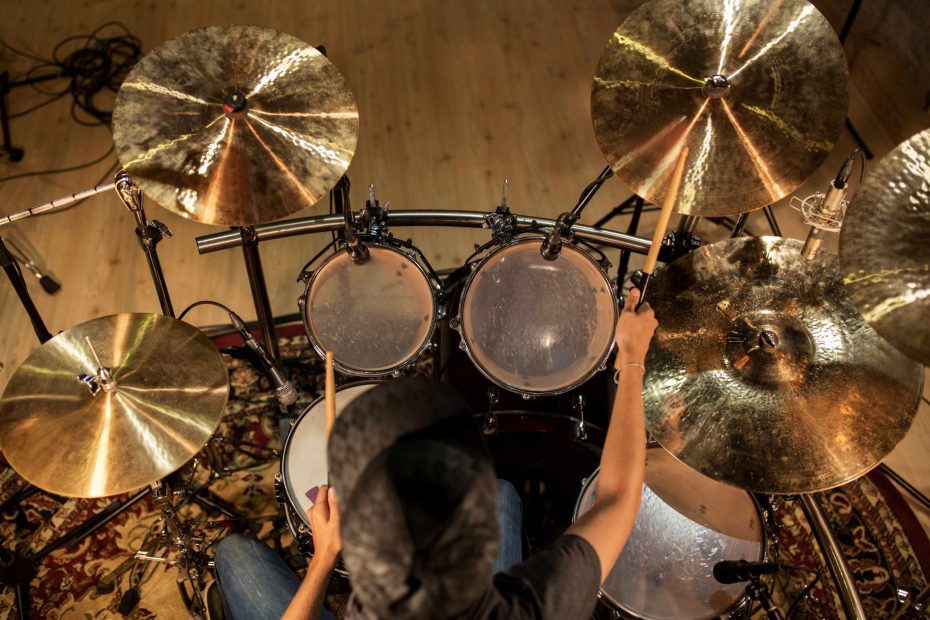
Hold your drumsticks like they’re alive, so they feel like they’re going to bounce out. You don’t want to clench down on them; if you do, your strokes will take twice as much effort as they need to, and your hands won’t allow the drums to actually rebound at all. When a stick can’t rebound, your wrists will be overworking, your tone will lack a sense of airiness, and your single strokes will get tired quickly, even at a slow tempo.
An effective grip will be all about balance. When you grip the stick between your thumb and index finger, allow your other fingers to lightly wrap around it but not clench. Allow your thumb to stay parallel to the side of your grip, not pressing down. Your index finger is a guide but shouldn’t squeeze hard enough to restrict the stick. You want your grip to be loose enough to allow the stick to bounce but tight enough to keep it in hand.
Try striking a practice pad or single stick with just one hand at a slow tempo. After striking the pad, see if the tip of your stick bounces back in the air. If the stick hits the pad and stays, it’s likely you’re squeezing too hard. If it falls out of your fingers or flies out of control, you’re not gripping firmly enough. You are holding the stick when the tip bounces back and your hands feel stable.
A big emphasis is on letting the wrist lead rather than the whole arm. Move the wrist to lift your stick, drop it down to the pad, and let rebound bring the stick back up. The shoulder should remain fairly still and the forearm should stay relaxed while the stick lifts and falls. Play quarter notes and let the tempo of the metronome feel comfortable for you, playing at a slower tempo so you can hear whether your notes are evenly spaced.
When you get louder and faster, most players try to grip tighter and harder. This may be an automatic response in your hands but will do the opposite, leading to less dynamics, less power, less speed, and less consistent timing. Instead, let your volume increase by lifting your stick higher with less tension in the grip, or let your volume decrease by lowering your height with less tension in your grip. This creates a direct correlation between dynamic changes and control.
Once you have a sense of comfort in your grip, begin alternating between your hands playing slower single strokes. Play slowly enough that you can count it with your mouth while you hit. This ensures that you won’t accidentally rush or drag on one side. Your right and left strokes should feel the same, rather than a weaker left side pulling itself up to keep with a stronger right side. If a single stroke feels more powerful on one side or falls behind, slow the tempo and observe what is causing that hand to grip too much, rise with the arm or be unable to rebound.
A good indicator won’t be how fast you’re playing, rather whether or not your stick is rebounding freely, your grip is relaxed, and your timing remains steady across several bars. When rebound helps out at least a part of the time, your playing won’t feel as if you’re pushing your sticks into the drum, but rather as if you’re guiding them back into time.